
Introduction
Hearing loss can profoundly impact a child’s development and a person’s overall quality of life. At Dr. Rao’s ENT Cochlear Implant Centre, we believe that early intervention can significantly improve a child’s educational and social development. Under the expert guidance of Dr. Shree Rao, a pioneering Cochlear Implant Super Specialist, we are deeply committed to the vision of a “deaf-free India.” For individuals with severe-to-profound hearing loss in both ears, bilateral cochlear implantation offers a life-changing solution.
Let’s explore how receiving implants in both ears can transform your hearing journey.
What is bilateral cochlear implantation?
Bilateral cochlear implantation involves surgically placing two electronic cochlear implant devices, one in each ear to treat severe-to-profound sensorineural hearing loss. While a single implant provides significant benefits, humans are naturally designed to hear with both ears, known as binaural hearing. Bilateral implants aim to restore this natural process, offering distinct advantages over using just one device.
Having an implant in each ear provides the brain with two opportunities to process auditory signals, a mechanism known as binaural redundancy, which significantly improves speech perception in noisy environments. It also creates a binaural summation effect, meaning sounds perceived from both ears seem slightly louder and clearer than sounds from just one. Furthermore, bilateral implants overcome the “head-shadow effect,” allowing users to hear sounds coming from any direction without their head physically blocking the audio signal.
Together, these mechanisms allow patients to experience superior sound localization, the ability to identify exactly where a sound is coming from and vastly improved speech understanding in both quiet and complex, noisy settings. For children, accessing these binaural cues early provides a critical foundation for acquiring language skills.
When is bilateral implantation recommended?
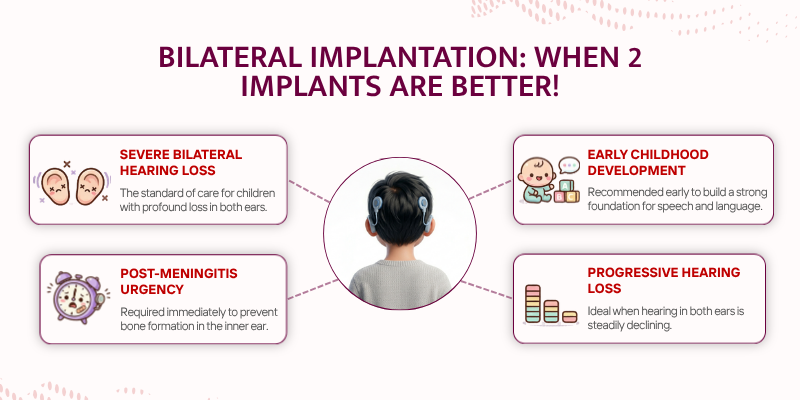
Bilateral cochlear implantation is considered the standard of care for children with severe-to-profound bilateral sensorineural hearing loss or progressive hearing loss. Early bilateral implantation is highly recommended for young children, as it supports the development of more typical bilateral auditory pathways, establishing a strong foundation for speech and language acquisition.
There are specific medical situations where bilateral implants are urgently recommended. For instance, children who become profoundly deaf following meningitis should be offered bilateral implants immediately. The inner ear can quickly undergo ossification (bone formation) after meningitis, which might completely prevent successful implantation if delayed. It is also recommended for patients with certain congenital inner ear anomalies, such as Mondini dysplasia, where a second implant may benefit depending on anatomical and functional factors.
For adults, the recommendation depends on individual circumstances. While bilateral implants are highly beneficial for adults with bilateral profound deafness, they are generally not recommended if the individual still retains significant residual hearing in one ear. In such cases, bimodal stimulation using a cochlear implant in one ear and a hearing aid in the other is often a better, more effective approach.
What is the difference between simultaneous and sequential implantation?
Bilateral cochlear implants can be placed in two ways: simultaneously (both ears during one surgery) or sequentially (one ear first, followed by the second ear in a later surgery).
Simultaneous implantation is often considered the gold standard, especially for children. It significantly reduces the total, cumulative time spent under anesthesia and in surgery compared to undergoing two separate procedures. Patients also benefit from a much shorter overall hospital stay. Most importantly, simultaneous surgery ensures that both ears are stimulated at the exact same time, often leads to better symmetry in auditory development and can improve outcomes. It is also generally more cost-effective for families and healthcare systems.
However, sequential implantation remains a highly viable and necessary option. It is often chosen when a patient has asymmetric hearing loss, where the second ear progressively worsens over time. Sequential surgery is also a safer alternative for patients with significant medical comorbidities, such as lung disorders, who cannot safely tolerate the prolonged anesthesia required for a simultaneous procedure. Sometimes, sequential implantation is also chosen based on parental preference or financial considerations.
Conclusion
Bilateral cochlear implantation is a remarkable advancement that mimics natural hearing, offering patients the ability to better manage conversations in noisy environments environments and localize sounds. We at Dr. Rao’s ENT Cochlear Implant Centre, are committed to supporting you and your child through every step of this transformative journey, from precise surgical care to comprehensive post-operative rehabilitation. If you or your loved one is struggling with severe hearing loss, don’t wait to seek help.
Take the first step towards a deaf-free life today. Book an appointment with Dr. Shree Rao at earsurgeon.in.
FAQs
What is bilateral cochlear implantation?
Bilateral cochlear implantation is a surgical procedure where cochlear implants are placed in both ears to treat severe-to-profound hearing loss.
What are the benefits of binaural hearing?
Binaural hearing improves sound localization, speech clarity, and the ability to understand conversations in noisy environments.
Is bilateral cochlear implantation better than a single implant?
Yes, bilateral implants provide better hearing balance, improved speech understanding, and more natural sound perception than a single implant.
When should a child get bilateral cochlear implants?
Early implantation, ideally in infancy or early childhood, is recommended to support proper speech and language development.
What is the difference between simultaneous and sequential implantation?
Simultaneous implantation involves both ears in one surgery, while sequential implantation is done in two separate surgeries at different times.
Can adults benefit from bilateral cochlear implants?
Yes, adults with severe hearing loss in both ears can benefit, but those with residual hearing may use one implant and one hearing aid instead.