
When parents or adult patients visit my clinic, their concerns go far beyond the medical. They ask: “Will my child hear music?” “Can they keep up in a noisy classroom?” “Will they feel left out?” These questions matter deeply; because hearing isn’t just about sound, it’s about connection, opportunity, and belonging.
My mission is simple: help create a Deaf-Free India, where no one is denied the chance to thrive due to hearing loss, geography, or lack of access to expert care. The good news? Modern cochlear implant technologies is making this possible in ways I couldn’t have imagined just years ago.
Today, we’re not simply providing a medical device; we’re offering sophisticated tools that empower patients to participate fully in culture, education, relationships, and the world around them. Let me walk you through some of these incredible advances.
Hearing Music in Full Color
In our Indian culture, music and art are woven into everyday life. Yet for many years, standard cochlear implants could only process sound through about 12 to 22 “channels” (like painting a beautiful landscape with just 20 colors).
Modern advanced systems now use “Current Steering” technology to create 120 or more spectral bands. Since our natural ear has roughly 3,500 hair cells tuned to different frequencies, this gets us remarkably close to how a healthy ear hears.
What does this mean in real life? A child learning classical Bharatanatyam can now hear the subtle tonal variations of a raga and synchronize their movements perfectly with a flute’s melody. They’re not just hearing sound; they’re feeling it. For music lovers of all ages, this is transformative.
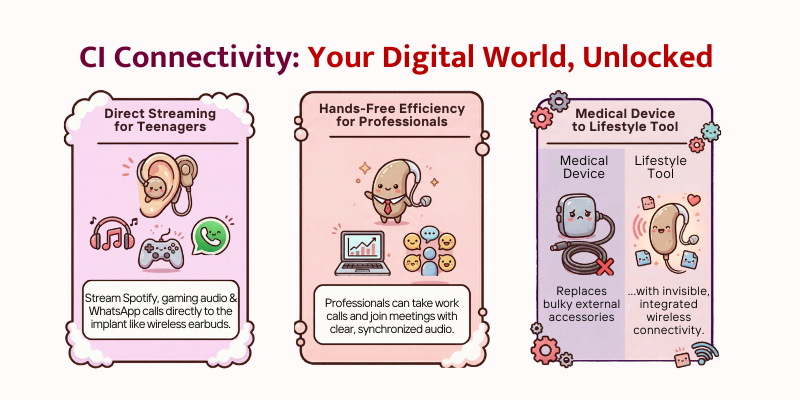
Staying Connected: Bluetooth for Teenagers and Professionals
Teenagers want to feel “normal,” and outdated cochlear implant designs (with bulky external accessories) can feel isolating. Modern implants have changed this completely.
Today’s devices feature true Bluetooth Classic connectivity, allowing you to stream music directly from Spotify, take WhatsApp calls hands-free, or connect to gaming headsets without any additional equipment. The implant itself acts as a wireless receiver, just like an AirPod or Bluetooth earphone.
This simple shift has a profound impact: the implant transforms from a medical device into an integrated lifestyle tool. For teenagers and working professionals, this means confidence, inclusion, and the freedom to feel like everyone else.
Safe Navigation: Hearing From Both Sides
For children born with severe hearing loss, receiving implants in both ears (bilateral implantation) is the best approach. Modern surgical protocols now use “Simultaneous Switch-On” technology, meaning both ears activate during a single appointment rather than waiting weeks between procedures.
This matters because two working ears give something called “localization” (the ability to know where sound is coming from). For children in India, this means safely navigating traffic by hearing if an auto-rickshaw is honking from the left, right, or behind them.
Two ears also create “directionality” in busy environments; the brain naturally spotlights the teacher’s voice in a noisy classroom while filtering out background chatter. This ability allows children to mainstream confidently into regular schools, fully included with their peers.
Synchronized Hearing for Busy Environments
Some adults lose hearing over time and benefit from a “bimodal” setup: a cochlear implant in the severely deaf ear and a hearing aid in the ear with some remaining hearing.
Historically, these devices operated separately (like two radio stations playing different channels in your head). This caused exhaustion and frustration.
Today, advanced hearing aid and implant manufacturers have created synchronized systems that communicate with each other automatically. Whether you’re in a busy office meeting or a crowded restaurant, they work together and adjust noise settings in concert. No more listening fatigue. No more struggle. Just clarity and confidence.
Cochlear Implant Technologies Supporting an Active Lifestyle
Parents often ask: “Will a cochlear implant hold my child back from sports or swimming?”
The honest answer is no. Children with implants play cricket, basketball, swim, and do everything their peers do. The external processor can be secured with a simple sports band, or removed entirely for swimming; the internal implant stays safely under the skin, protected and waterproof.
Even better: modern implants are 3T MRI compatible. In the past, if someone needed an MRI scan, we had to surgically remove the internal magnet (an unnecessary procedure). Today, patients can keep the magnet in place and safely have high-resolution MRI scans without any issues. This means uncompromised healthcare throughout their entire life.
Let’s Walk This Journey Together
At Dr. Rao’s ENT Cochlear Implant Center, my team and I believe in an empathetic, patient-first approach. We combine surgical precision with compassionate, lifelong care. We’re not just treating hearing loss; we’re unlocking a lifetime of possibilities.
If you or a loved one are navigating hearing loss and want to explore how modern cochlear implants can improve your life, I’d love to help.
Schedule an Appointment with us today to discuss your options.
You can also explore more educational resources and real patient stories by subscribing to my YouTube channel.
Remember: hearing is a journey, not a destination. And you’re not walking it alone.
FAQs
What are cochlear implant technologies?
Cochlear implant technologies are advanced medical systems that bypass damaged parts of the inner ear and directly stimulate the auditory nerve to provide a sense of sound.
Can cochlear implants help in hearing music clearly?
Yes, modern cochlear implant technologies use advanced processing like current steering, enabling users to perceive music with better clarity and tonal detail.
Are cochlear implants suitable for children?
Absolutely. Children with severe hearing loss can benefit greatly, especially with early implantation, helping them develop speech, language, and social skills.
Do cochlear implants support Bluetooth connectivity?
Yes, many modern devices come with Bluetooth connectivity, allowing users to stream calls, music, and audio directly from smartphones and other devices.
Is it safe to play sports or swim with a cochlear implant?
Yes, users can participate in sports. External processors can be secured or removed for swimming, while the internal implant remains safe under the skin.
What is the benefit of bilateral cochlear implants?
Bilateral implants help users localize sound, improve speech understanding in noisy environments, and enhance overall hearing experience.