
When parents come for initial consultations, they ask many questions about their child’s future.
Will my child do well in school?
Can they participate in activities with their peers?
Will they feel included in social settings?
One question we hear often is about music. Can my child enjoy music after a cochlear implant?
This is a valid concern because music is woven into childhood. From birthday parties to school events to family gatherings, music is everywhere. In this article, we focus specifically on music perception after cochlear implantation so you can make an informed decision.
How Cochlear Implants Process Music (And Why It’s Different)
Your ear works like a sophisticated sensor. It captures every nuance, the soft notes, the sharp instruments, the warmth in a singer’s voice. A cochlear implant works differently. It converts sound into electrical signals sent directly to the hearing nerve. Think of it like this: a normal ear hears a piano playing all its rich tones. A cochlear implant hears the rhythm and overall shape of the music, but misses some of the finer details that make each note distinct.
Cochlear implants are optimized for speech, not music. They process the timing and loudness of sounds very well but struggle with the precise frequencies that define musical pitch and instrument sounds. This means your child may recognize a song’s rhythm or lyrics but have difficulty perceiving the melody as clearly as their hearing peers do.
Understanding Bimodal Hearing and Bilateral Listening
If you’ve heard terms like “bimodal” and “bilateral,” don’t worry. These are simply different ways to use technology to improve hearing after implantation.
Bimodal means using a cochlear implant in one ear and a hearing aid in the other ear.
Bilateral means using cochlear implants in both ears.
Both approaches can significantly improve how your child perceives music compared to using a single implant alone.
Bimodal Listening: Pairing an Implant with a Hearing Aid
Bimodal listening combines the strengths of two different technologies:
What happens:
- The cochlear implant captures the rhythm and overall pattern of music
- The hearing aid in the other ear captures acoustic details—especially the pitch and tonal qualities
- Together, they work as a team to create a richer picture of the sound
Benefits for music:
- Better perception of melody and pitch (the main improvement parents notice)
- Improved recognition of lyrics in songs
- More natural-sounding music overall
- Users often report hearing in “stereo,” which makes music more enjoyable
- Research shows bimodal users express significantly higher satisfaction with music listening compared to those using one implant alone
When bimodal works best: If your child has some residual hearing in their non-implanted ear, bimodal listening can be very effective. This is especially true for children whose hearing loss is less severe or who are implanted later in childhood.
Bilateral Listening: Two Implants, Two Ears
Bilateral listening means both ears have cochlear implants. This approach is increasingly common and offers distinct advantages for music perception.
Benefits for music:
Aspect | Single Implant | Bilateral Implants |
Melody Recognition | Difficult; relies on rhythm and lyrics | Significantly improved; both ears process pitch information |
Instrument Identification | Challenging | Much better ability to distinguish instruments |
Overall Music Enjoyment | Limited; sounds mechanical or unclear | More natural and enjoyable listening experience |
Sound Direction | Cannot locate where sound comes from | Can tell where music is coming from (stereo effect) |
Future Technology | Limited options | AI and advanced processing can work with both implants for better results |
Research clearly shows that children with bilateral implants demonstrate higher musical enjoyment and report experiences closer to their hearing peers. They score significantly higher on tasks involving instrument recognition and appreciate music with lyrics much more. Additionally, newer artificial intelligence technology can analyze input from both implants simultaneously and adjust settings in real time for even better clarity.
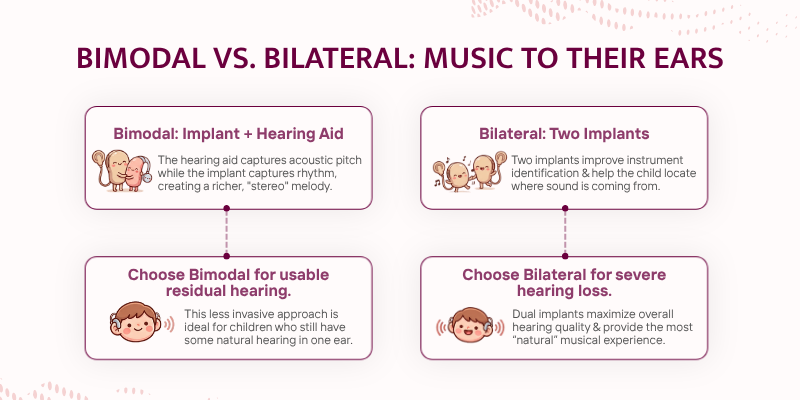
Which Option Should You Choose?
This depends on several factors:
Choose bimodal if: Your child has usable residual hearing in one ear and you want a less invasive approach. Bimodal listening is very effective and may be recommended by your surgeon based on your child’s specific hearing profile.
Choose bilateral if: Your child has severe to profound hearing loss in both ears, or if you want to maximize music perception and overall hearing quality. Bilateral implants give your child access to sound from both sides of the brain, which is crucial for developing normal listening skills during childhood.
The surgical perspective: Your surgeon will evaluate your child’s hearing ability in both ears and recommend the best option. The decision depends on factors like the degree of hearing loss, your child’s age, and their auditory development stage.
Making an Informed Choice
The reality is this: after a cochlear implant, music will sound different than it does for hearing children. But “different” doesn’t mean “bad.” Many children with implants enjoy music, participate in school performances, and develop personal musical preferences. Some even become “star performers” who achieve music perception close to their hearing peers, especially if they have prior musical training.
The best outcomes happen when families have clear expectations, follow through with auditory and speech therapy, and give their child consistent exposure to music. Over time, the brain learns to interpret electrical signals as meaningful sound, and children adapt remarkably well.
More importantly, remember that music is one aspect of your child’s life. The bigger picture is that cochlear implants open doors to communication, education, and connection with the hearing world. Many parents find that their child’s improved ability to hear speech, engage in conversations, and participate in daily activities far outweighs any limitations with music perception.
Ready to Discuss Your Child’s Options?
If your child has hearing loss and you’re considering cochlear implantation, we’re here to help. Music perception is just one piece of the conversation. Dr. Shree Rao can discuss your child’s specific situation, explain bimodal and bilateral options, and help you understand what realistic expectations are for your family.
Schedule a consultation with Dr. Rao’s ENT Cochlear Implant Center to get personalized guidance tailored to your child’s needs.
FAQs
Can children enjoy music after cochlear implantation?
Yes, children can enjoy music after cochlear implantation. While it may sound different, many children recognize rhythm, lyrics, and gradually improve their listening experience over time.
Why does music sound different with a cochlear implant?
Cochlear implants are designed primarily for speech processing, so they capture rhythm and loudness well but may miss fine pitch and tonal details in music.
What is bimodal hearing in cochlear implant users?
Bimodal hearing means using a cochlear implant in one ear and a hearing aid in the other. This combination helps improve pitch perception and overall music quality.
Is bilateral cochlear implantation better for music perception?
Yes, bilateral cochlear implants generally provide better music perception, improved sound direction, and a more natural listening experience compared to a single implant.
Which is better for my child: bimodal or bilateral hearing?
It depends on your child’s hearing condition. Bimodal works well if there is residual hearing, while bilateral implants are ideal for severe hearing loss in both ears.
Can music perception improve over time after implantation?
Yes, with consistent auditory training and exposure, the brain adapts to sound signals, and children can significantly improve their music perception skills over time.