
A cochlear implant is a life-changing device that opens up a world of sound, but it naturally brings up practical questions about daily routines, travel, and safety. Let us address some of the most common questions my patients ask me about life after a cochlear implant.
Is it safe to wash your hair after getting a cochlear implant?
Yes, but you will need to take a brief pause right after your procedure. You should be able to shower and wash your hair one week after your surgery, unless your surgeon instructs you otherwise. During this initial recovery period, it is very important to keep water out of your ear to allow the surgical site to heal properly. Once your incision has completely healed, you can shower normally, but you must remove your external sound processor before stepping in the water, as the internal implant under your skin is completely safe on its own.
What happens if a cochlear implant gets wet?
Your cochlear implant system has two parts: the internal implant and the external sound processor. The internal implant is surgically placed under the skin and is entirely waterproof. However, if your external sound processor gets wet from sweat, a sudden rainstorm, or accidental splashing, moisture can potentially damage the delicate electronics. If your device gets wet, you should immediately dry it and place it in a specialized dehumidifier or drying unit overnight. Using a drying unit daily is highly recommended anyway, as it acts as a dehumidifier to remove natural moisture and oils, which can extend the lifespan of your device and prevent the need for repairs.
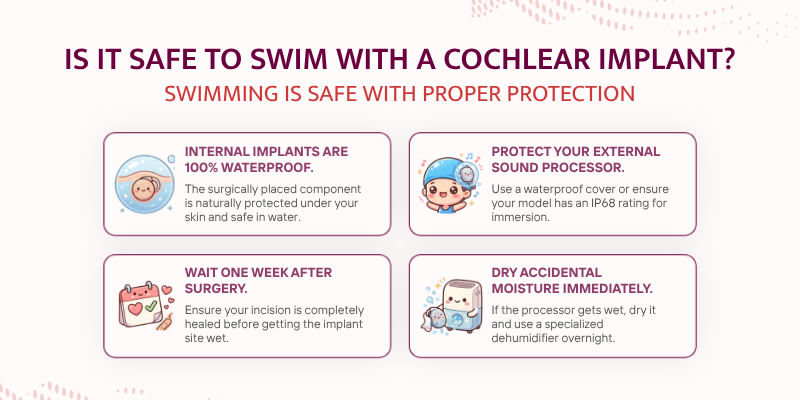
Is it safe to swim with a cochlear implant?
Absolutely! Swimming is one of life’s greatest pleasures, and you do not have to give it up. As soon as you have healed from surgery, the internal component is safe in the water. For your external processor, safety depends on your specific model.
Modern processors, have a high IP68 waterproof rating. This means they can be submerged in fresh water up to 1 meter deep for 60 minutes. If you plan on swimming in saltwater, chlorinated pools, or if you have an older processor, you can simply use a waterproof accessory, which fully protects your device while allowing you to hear clearly in the water.
Can I wear headphones and listen to music with a cochlear implant?
Yes, you can easily enjoy your favorite music! You can wear larger, over-the-ear headphones that fully enclose your processor’s microphones. Noise-canceling headphones work wonderfully for cochlear implant users because they block out background noise without causing the feedback or whistling that often occurs with traditional hearing aids.
Better yet, many modern cochlear implant processors feature built-in Bluetooth technology. This allows you to wirelessly stream music, podcasts, and phone calls directly from your iPhone, iPad, or Android device straight to your implant without needing headphones at all.
Is it safe to fly with a cochlear implant?
Yes, it is perfectly safe to fly. Most people are cleared by their surgeon to fly within 1 to 2 weeks after their surgery, provided they are not experiencing significant pain or dizziness. When traveling, always pack your spare sound processors, extra batteries, and chargers in your carry-on luggage. Never put your spare processor in checked baggage, as the higher-level X-ray machines used for checked bags can damage the device.
Is a cochlear implant detected by a metal detector?
When passing through airport security scanners or metal detectors, your implant may activate the alarm. It is always a good idea to let security personnel know that you have an implanted medical device for hearing and to show them your Patient Identification Card.
Security may use a hand-held scanning wand to screen you; this wand will not harm your implant, but it will beep when it passes over your sound processor. Additionally, the magnetic fields from these scanners can cause loud, distorted sounds, so it is highly recommended to turn the volume down or switch your processor off before walking through.
Is it safe to undergo an MRI scan with a cochlear implant?
Yes, cochlear implants are generally “MR Conditional,” meaning you can safely undergo an MRI scan under specific conditions. Newer implant models, allow you to have high-strength 1.5T and 3T MRI scans with the internal magnet left in place.
For some older models, the internal magnet may need to be temporarily removed through a minor surgical procedure, or a special splint kit must be applied before the scan. Always inform your radiology center that you have a cochlear implant and consult with your clinician to ensure the proper guidelines for your exact implant model are followed.
Your Next Steps to Better Hearing
Living with a cochlear implant requires a few simple adjustments, but it ultimately empowers you to live a full, active life without limitations. Early intervention and the right support are key to successful rehabilitation.
If you or a loved one are experiencing hearing loss and want to explore if a cochlear implant is the right choice, our team is here for you. We provide comprehensive care from diagnosis through audio and speech therapy to ensure the best possible outcomes.
Take the first step toward a world of sound!
Schedule your consultation with Dr. Shree Rao today by visiting https://earsurgeon.in/book-an-appointment/. Don’t forget to follow our Instagram page and subscribe to our YouTube channel for more tips on protecting your ear health!
FAQs
How soon can I return to normal life after a cochlear implant?
Most people resume normal activities within 1–2 weeks after surgery, depending on healing and doctor guidance.
Can I shower or wash my hair after a cochlear implant surgery?
Yes, after about a week. Keep the surgical area dry initially and always remove the external processor before showering.
Is it safe to swim with a cochlear implant?
Yes, once healed. The internal implant is waterproof, and the external processor may require a waterproof accessory.
Can I listen to music with a cochlear implant?
Yes, you can use over-ear headphones or stream music directly via Bluetooth-enabled processors.
Are cochlear implants safe during air travel and airport security checks?
Yes, flying is safe. Inform security staff, carry your ID card, and consider turning off the processor during scanning.
Can I undergo MRI scans with a cochlear implant?
Yes, but only under specific conditions. Always inform your doctor and radiologist about your implant model.