
I still remember a mother asking me quietly, “Doctor, what did we do wrong?” The answer is almost always nothing. Many parents reach me after a failed newborn screen, carrying guilt and a folder of reports. In my practice, I explain that genetic testing for hearing loss can often give a clear reason for a child’s deafness, and that clarity shapes treatment choices and family decisions. Here is how it works, in plain words.
Why So Much Childhood Deafness in India Is Genetic
Genes are the body’s instruction manual, and some changes in them can stop the inner ear from working normally. Studies across many countries suggest that a large share of hearing loss present from birth has a genetic cause, often cited as around half, though figures vary by population. In India, infections such as rubella and meningitis, and complications around birth, also play a role, so genes are not the only explanation.
Most genetic deafness is recessive, meaning both parents carry one silent changed copy and hear perfectly well themselves. Their child receives both copies. Hearing loss may be non-syndromic, affecting only hearing, or syndromic, occurring alongside other features such as vision or kidney changes. In communities where marriage between relatives is customary, carrying the same silent change is more likely, which is why families in Telangana and across India often discover this cause only after the first affected child.
Connexin 26 (GJB2): The Most Common Gene and What a Positive Result Means
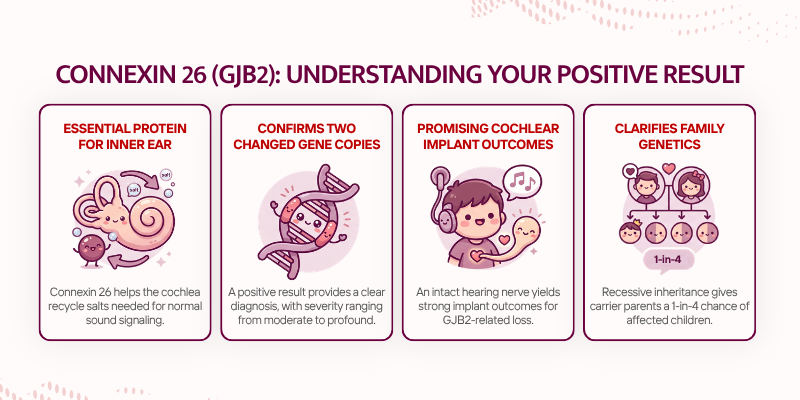
Connexin 26 is a protein that helps the cochlea, the snail-shaped hearing organ, recycle salts needed for sound signalling. Changes in the GJB2 gene that makes it are among the most frequent causes of recessive non-syndromic deafness worldwide. In some Indian studies, GJB2 explains a smaller share than in Western reports, and genes such as SLC26A4 also contribute, which is why testing now often uses panels covering many genes at once.
A positive result means two changed copies were found and a likely cause is confirmed. Severity still varies, from moderate to profound, so audiology testing remains essential. Some results are labelled variants of uncertain significance, meaning scientists cannot yet say whether the change is harmful. Such results are reviewed again as knowledge grows, and they should not be over-interpreted.
How Genetic Results Influence Implant Decisions and Outcome Expectations
A genetic result does not decide alone whether a child receives a cochlear implant, a device that sends sound signals directly to the hearing nerve. That decision rests on hearing tests, scans, and an implant candidacy evaluation, with the genetic report adding useful context.
In GJB2-related loss, the hearing nerve is usually intact, and published reports generally describe good speech and listening progress after implantation. Many of these studies are small and differ in design, so outcomes cannot be promised for any one child. Results pointing to syndromes, such as Usher syndrome, prompt early vision checks and adjusted planning. Changes in the OTOF gene, linked to auditory neuropathy, are of interest because experimental gene therapy trials have begun, though these are early, small studies and not routine care. Implants remain the established option today.
Family Counselling: Siblings, Future Pregnancies, and Consanguinity Questions
When both parents carry a recessive change, each pregnancy has a one in four chance of an affected child. Siblings can be tested, and hearing siblings are often carriers, which matters mainly for their own future families. For a new pregnancy, newborn hearing screening and early audiology follow-up allow quick action.
Questions about consanguinity deserve gentle handling, never blame. Genetic counsellors explain carrier risk, and Dr. Shree Rao encourages including grandparents in these conversations, in whichever language the family is comfortable with. Readers wanting broader background can explore genetics in ear disorders and surgery on our sister site.
Conclusion
Genetic testing for hearing loss turns an unanswered “why” into practical guidance, informing implant planning, outcome expectations, and family choices. If your child has been diagnosed with hearing loss, gathering the screening report and audiograms is a helpful first step, and you may book an appointment when you are ready to discuss what testing could mean for your family.
FAQs
How is the test done, and how long do results take?
A small blood or saliva sample is usually enough, from the child and often both parents. Results commonly take a few weeks, depending on the laboratory and the panel used.
Does a negative result mean the hearing loss is not genetic?
Not necessarily. Current tests cannot detect every change, and some causes are still unknown. A negative report may be revisited later, and treatment is planned from hearing and imaging findings regardless.
When should we meet a specialist after diagnosis?
As soon as hearing loss is confirmed, since early childhood is a key period for speech development. Many families seek an opinion from the best cochlear implant specialist in India with their screening report, audiograms, and any genetic report in hand, so the team can review everything together. A team including audiologists and speech therapists helps greatly after surgery.