
In my clinic, one of the most common questions from families is whether a cochlear implant needs replacing once it has worked well for several years. Many people assume that a cochlear implant processor upgrade means another operation, and that assumption often causes needless worry. In most cases it does not. This article explains how the two parts of a cochlear implant differ, what newer processors offer, how compatibility is determined, and what the upgrade involves, so that patients and parents can plan with clear expectations.
Internal and external parts: why upgrades do not mean repeat surgery
A cochlear implant has two main components. The internal implant includes a receiver placed beneath the skin and an electrode array inserted into the cochlea during surgery. This part is designed to remain in place for a long time and is generally not changed when a newer processor becomes available. The external sound processor sits behind the ear, picks up sound through its microphone, and sends processed signals across the skin to the internal implant. This two-part design is described in standard texts (Clark, 2003). Dr. Shree Rao’s practice explains this division to patients because it clarifies why an upgrade is a far smaller step than surgery. The processor carries updated software, improved hardware, and new accessories, while the surgical foundation stays the same. Patients who upgrade generally keep their existing internal implant, so repeat surgery is not part of the usual pathway.
What newer processors add: noise handling, connectivity, water resistance
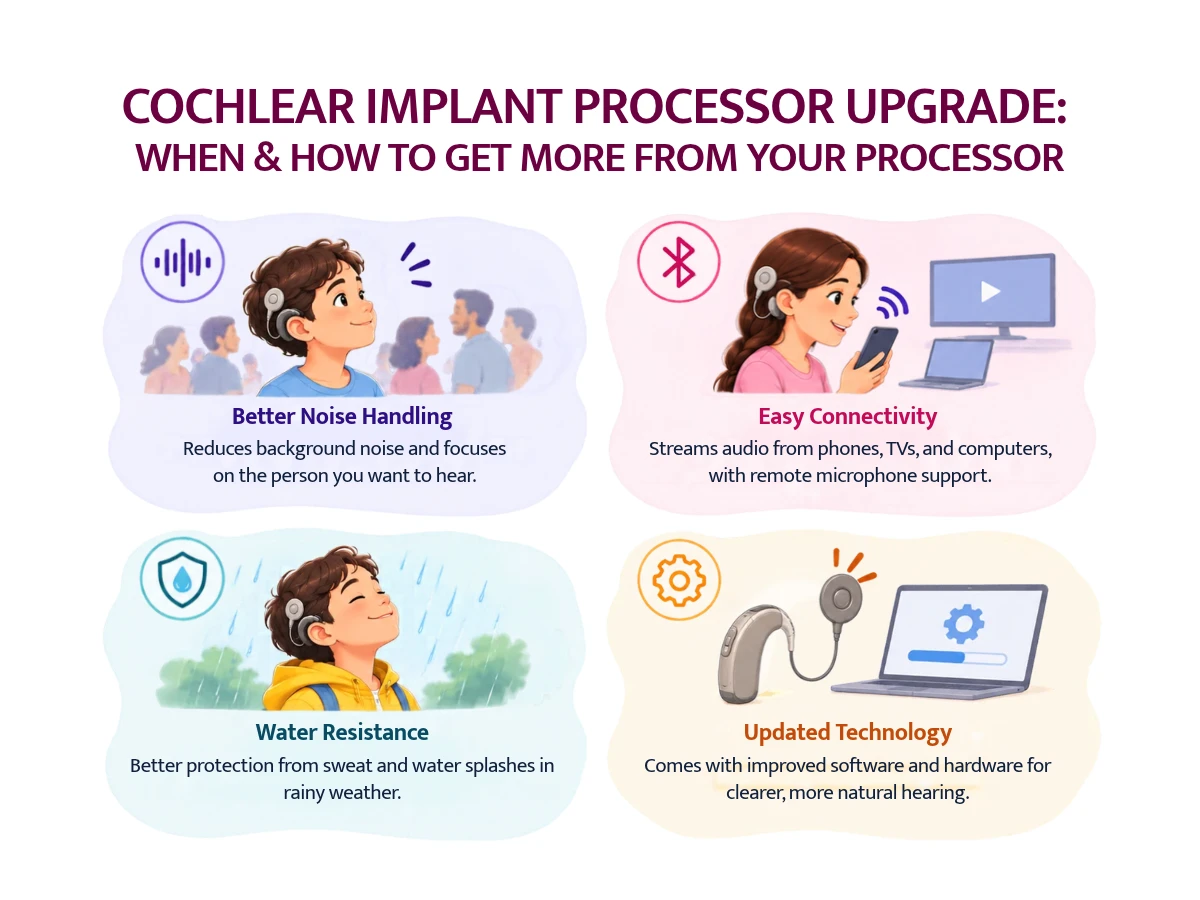
Newer processors refine how sound is analysed before it reaches the electrodes. Noise reduction and directional microphone settings help the listener follow one speaker in a crowded room, a common challenge in busy Indian households, markets, and classrooms. Research on speech recognition in noise has shown that the clarity of spectral information strongly influences how well people understand speech against background sound (Friesen, Shannon, Baskent and Wang, 2001).
Connectivity is the second area of progress. Many current processors stream audio from phones, televisions, and computers, and some pair with remote microphones that help in classrooms. Water resistance matters in Hyderabad during the monsoon, when humidity and sudden downpours are common. Many newer processors carry water and sweat resistance ratings, but these differ by model. Families should read the manufacturer’s specification rather than assume full waterproofing, since heavy rain or swimming may still call for removing the device. Patients who want to understand how these advances developed can read about technologies transforming cochlear implants.
Compatibility: which processors work with which internal implants
Compatibility is decided by the manufacturer and the specific internal implant model. A processor is engineered to communicate with particular receiver and electrode generations, so a device from one manufacturer generally cannot be paired with an implant from another. Even within the same manufacturer, a newer processor may support some older internal implants but not all of them. Current designs and likely future developments are reviewed in the literature (Wilson and Dorman, 2008), but the practical question for any patient is simpler: which processors does this implant support?
The first step in any cochlear implant processor upgrade is therefore identifying the implant model, which is recorded on the implant identification card issued after surgery and in the surgical records. The implant centre can then confirm which processors are supported. Families should not purchase an external device before this check is complete. Where a newer processor is compatible, the internal implant stays in use and the change is confined to the external hardware and its software.
The upgrade process: cost planning, remapping, and adjustment period
Planning begins with cost. Processors are a significant expense, and the total includes the device, accessories, audiologist consultation, and programming sessions. Health insurance coverage for external processors varies by policy and insurer, so patients should check the terms in writing before committing. Some families also explore government assistance, such as the Assistance to Disabled Persons (ADIP) scheme, which may cover part of the cost for eligible beneficiaries.
Once the new processor arrives, an audiologist performs remapping. This creates a new listening program, or MAP, based on the patient’s existing settings and current responses to sound. Remapping is the stage where the processor is tuned to the individual, and it often takes several sessions. The adjustment period follows. Sounds may seem different at first, sometimes sharper or more mechanical, and the brain needs time to adapt to the updated input. Most patients settle over the following weeks with regular follow-up. Routine care, including cleaning, battery management, and checks for wear, supports the performance of the new device, and these basics are covered in cochlear implant maintenance basics. Patients who wish to begin an evaluation can book an appointment at earsurgeon.in/book-an-appointment/.
FAQs
Does a cochlear implant processor upgrade require surgery?
No. The internal implant usually stays in place, and the upgrade concerns the external processor. Surgery is considered only if the internal device itself is damaged or no longer functioning.
Can an older processor be kept as a backup?
Some families keep an older processor for emergencies. Whether it can be used alongside a newer model depends on the manufacturer and the model, so the audiologist should confirm before any use.
Where can families find general information on cochlear implant care?
Families can read general information on cochlear implant care through EarSurgeon at earsurgeon.in.
Conclusion
A cochlear implant processor upgrade is a planned change to the external device, and for most patients it leaves the internal implant in place. Compatibility checks, cost planning, and careful remapping determine how much benefit the change delivers. Dr. Shree Rao is one of India’s leading cochlear implant specialists, and her clinical approach centres on each patient’s listening goals at every stage of the process. Anyone considering an upgrade should begin with a review of their implant records and current hearing performance.