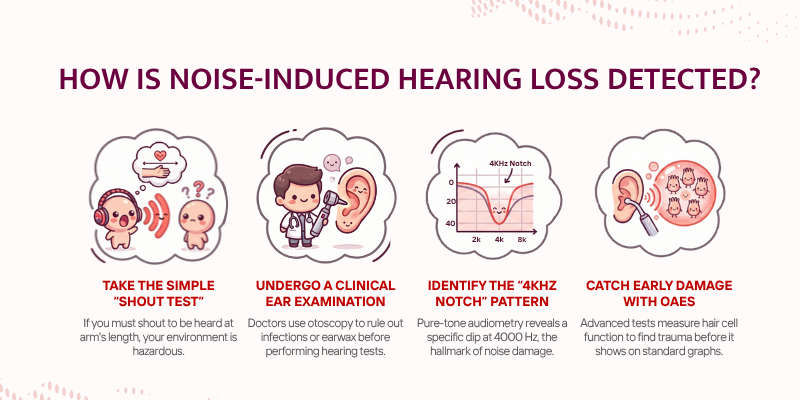
“Do you often have to shout to talk to someone at arm’s length because it’s so noisy around you?”. If your answer is yes, your environment is potentially hazardous to your hearing. This single, simple question is known as the “shout test”. It is a quick and effective screening method that hearing specialists like myself use to quickly identify excessive workplace or recreational noise exposure.
But what happens when you fail the shout test day after day? Let us explore the reality of noise-induced hearing loss and how it affects your ears. I’m Dr. Shree Rao, hearing restoration and cochlear implant specialist. I’ll explain the nuances of noise-induced hearing loss, how to protect your ears from NIHL (Noise-Induced Hearing Loss), and what are your treatment options in case of NIHL.
What is noise-induced hearing loss
Noise-induced hearing loss (NIHL) is a permanent sensorineural hearing deficit. It happens when high sound pressure levels exert extreme mechanical shearing forces on the delicate structures of your inner ear. This can occur suddenly from an acute, explosive sound reaching 140 to 170 decibels, causing immediate acoustic trauma.
More commonly, it develops gradually from chronic exposure to loud, relentless noises. The intense sound breaks down the stereocilia of your inner ear’s hair cells, leading to premature cell death. Because human auditory sensory cells cannot regenerate, this type of hearing loss is irreversible. It is a serious occupational hazard. However, it is also virtually 100% preventable.
How is noise-induced hearing loss detected
Detecting NIHL requires a combination of clinical history and specific audiological tests. A doctor will start with an otoscopic examination of your ear canal and eardrum to ensure the hearing loss is not simply caused by an infection or impacted earwax.
The gold standard test for diagnosis is pure-tone audiometry. This test is conducted in a sound-treated room and measures your hearing thresholds across various frequencies. Advanced objective tests, such as otoacoustic emissions (OAEs), can also be utilized. OAEs measure outer hair cell function and are highly sensitive, often catching acoustic trauma even before it appears on a standard audiogram.
What is the 4kHz dip or notch in an audiogram
When pure-tone audiometry is performed, NIHL leaves a very specific fingerprint on the results. This is classically known as the 4 kHz notch. Your hearing thresholds might be perfectly normal at lower frequencies, but the audiogram will reveal a distinct dip specifically at 4000 Hz (4 kHz), with some hearing recovery at 8000 Hz.
This happens because the 4 kHz frequency corresponds to the basal turn of the cochlea. This anatomical region is uniquely vulnerable to damage due to its physical rigidity and the natural acoustic resonance of the human ear canal. To put this in perspective, consider a real-world Indian example. A clinical study evaluating traffic police personnel in the second-tier city of Darbhanga, Bihar, found that 45% of the officers suffered from hearing loss due to relentless urban traffic noise.
The most common audiometric pattern observed among these Indian officers was bilateral sensorineural hearing loss with this exact, classical 4 kHz notch.
How to protect your ears in a noisy environment
Since permanent structural damage cannot be cured, prevention is your best defence. If you work in a loud industry or enjoy noisy hobbies, you must take proactive steps:
- Utilise hearing protection devices: Always wear correctly fitted earplugs or earmuffs. In extremely hazardous environments, wearing both earplugs and earmuffs simultaneously can provide over 40 decibels of protection.
- Follow the 60-60-60 rule: When using personal audio devices, keep your volume at a maximum of 60%, listen for no more than 60 minutes at a time, and ensure the volume stays under 60 decibels.
- Implement administrative controls: Workplaces should rotate staff to minimise exposure times and schedule the noisiest tasks during low-occupancy hours.
- Upgrade your headphones: Swap out standard earbuds for noise-cancelling, muff-type headphones. This actively suppresses background interference, reducing your urge to crank the volume to unsafe levels.
You can learn more about protecting your hearing in my ”Deaf Free India” podcast with Dr. Pal here.
What are the signs you are affected by noise-induced hearing loss
Because NIHL damages high-frequency processing first, it can easily sneak up on you. Look out for these common warning signs:
- The “cocktail party effect”: You experience immense difficulty understanding conversations in noisy backgrounds, such as busy restaurants or social gatherings.
- Muffled voices: You frequently feel like the people around you are “mumbling” or failing to speak clearly.
- Missing high-pitched consonants: Sounds like “s,” “sh,” and “t” become incredibly difficult to hear and distinguish.
- Ringing ears: You suffer from tinnitus, a persistent ringing or buzzing in the ears, which often accompanies chronic noise exposure.
When are cochlear implants recommended
When noise damage is extensive and traditional amplification is no longer effective, cochlear implants are the recommended medical treatment. Chronic noise exposure can eventually create “dead regions” in the cochlea where inner hair cells are entirely destroyed. When average hearing thresholds exceed 60 to 65 dB HL and word recognition drops below 60%, patients derive massive benefit from implantation. These devices bypass the destroyed hair cells to electrically stimulate the auditory nerve directly.
For patients who have a severe high-frequency loss but retain their low-frequency hearing, hybrid cochlear implants are recommended. They brilliantly merge electrical stimulation for high pitches with acoustic amplification for low pitches, restoring both clarity and music appreciation.
When are hearing aids recommended
For individuals experiencing mild to moderately severe NIHL, hearing aids are the primary, first-line intervention. Modern hearing aids are highly sophisticated. They can be precisely programmed to provide high-pitch amplification, specifically targeting the frequencies you have lost while maintaining natural sound quality for the pitches you can still hear.
Furthermore, they utilize directional microphones and advanced artificial intelligence to actively separate human speech from chaotic background noise. This effectively combats the frustrating “cocktail party effect,” making conversations clear and enjoyable again.
What next?
Hearing is a fragile sense that connects us to the world. A quick shout test can tell you if your workplace is putting that sense in jeopardy. Noise-induced hearing loss is permanent, but it does not have to be inevitable. By understanding the risks, recognising the early warning signs like the 4 kHz notch, and using proper ear protection, you can take control of your auditory health. Value your hearing today, so you can continue to enjoy the sounds of tomorrow.
If you are worried about hearing loss due to workplace conditions, feel free to reach out to Dr. Shree Rao, best cochlear implant specialist in India to clear your worries. You can get an evaluation done at Dr. Rao’s ENT Cochlear Implant Clinic by booking an appointment here.
FAQs
What is the shout test for noise-induced hearing loss?
The shout test is a simple screening method where needing to shout to communicate at arm’s length indicates potentially hazardous noise levels.
Is noise-induced hearing loss permanent?
Yes, noise-induced hearing loss is usually permanent because the damaged inner ear hair cells cannot regenerate.
What are early signs of noise-induced hearing loss?
Early signs include difficulty hearing in noisy places, muffled speech, missing high-pitched sounds, and ringing in the ears (tinnitus).
What is the 4 kHz notch in an audiogram?
It is a characteristic dip at 4000 Hz seen in hearing tests, commonly associated with noise-induced hearing loss.
How can I prevent noise-induced hearing loss?
You can prevent it by using ear protection, limiting exposure time, following safe listening habits, and using noise-cancelling headphones.
What treatments are available for noise-induced hearing loss?
Treatment options include hearing aids for mild to moderate loss and cochlear implants for severe hearing damage.