Sitting in a doctor’s office and learning that your child’s ears are not functioning can be an incredibly devastating moment. As a parent, you are immediately flooded with worries, often asking through tears, “Will my child ever speak? Will they be able to go to a normal school?”.
The answer is a resounding yes. Thanks to modern cochlear implants & hearing technology, early intervention can completely change a child’s educational and social trajectory. However, as you begin researching solutions, you are likely to be bombarded with complex medical and engineering terms. Dr. Shree Rao, an empathetic, patient-centric pediatric ENT and cochlear implant super-specialist with over 200 successful surgeries, believes that parents shouldn’t need a medical degree to make an informed decision for their child.
To help give you peace of mind on this journey, we have decoded the most common technical jargon you will encounter when choosing a cochlear implant for your little one.
1. T-Mic and Input Dynamic Range (Catching Every Sound)
- The Jargon: T-Mic, Input Dynamic Range (IDR).
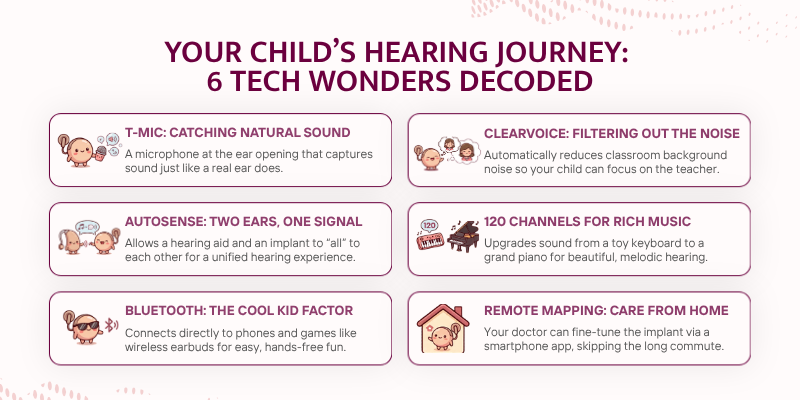
- What it actually means: When we talk about “Input Dynamic Range,” we are simply talking about the implant’s ability to capture the widest variety of sounds—from the softest whispers in a quiet house to loud noises outside. To achieve this, some advanced systems use a T-Mic, a microphone that sits right at the natural opening of the ear canal. Instead of sitting behind the ear, it captures sound exactly the way a normal ear does, helping your child learn through natural, everyday listening.
2. ClearVoice (Focusing Through the Chaos)
- The Jargon: ClearVoice, Noise-Canceling Sound Coding Strategy.
- What it actually means: Indian classrooms are often loud, filled with the hum of ceiling fans, chatter from 30 to 40 kids, and traffic from outside. If a child has to strain to hear the teacher over this noise, their brain becomes exhausted. ClearVoice is an advanced, FDA-approved technology that acts like a smart filter. It constantly listens to the room, automatically detecting and reducing background noise while elevating human speech. This allows your child to enjoy an “effortless listening” experience, relaxing their brain so they can focus on math, reading, and just being a kid.
3. Bimodal Hearing Technology and AutoSense OS (Two Ears Working as One)
- The Jargon: Bimodal Hearing, Linked Hearing Aids, AutoSense OS.
- What it actually means: Sometimes a child has profound hearing loss in one ear (requiring an implant) but moderate loss in the other (requiring a hearing aid). Traditionally, wearing two different devices felt like listening to two different radio stations at once, or watching a movie where half the screen is in black-and-white and the other half is in 3D 4K—it forces the brain to work incredibly hard to sync the two. Modern linked systems use shared software called AutoSense OS. This means the hearing aid and the cochlear implant literally talk to each other using the same computer chip, treating sound the exact same way so your child’s brain receives one clear, unified signal.
4. Current Steering and 120 Channels (Hearing the Grand Piano)
- The Jargon: Current Steering, Spectral Information, Virtual Channels.
- What it actually means: Standard implants use around 12 to 22 “channels” to deliver sound, which is like playing music on a small toy keyboard with only a few keys. Current steering technology creates up to 120 virtual channels, acting more like a grand piano. This massive upgrade allows the implant to process up to 466 distinct pitches, giving your child the ability to hear the rich, emotional micro-tones of music, rather than just flat, robotic sounds.
5. Universal Bluetooth (The Cool Gadget Factor)
- The Jargon: Universal Bluetooth Connectivity, Wireless Streaming.
- What it actually means: As your child grows into a teenager, they will want to fit in. Universal Bluetooth turns their medical device into a high-tech, wireless earbud. Without needing extra equipment, they can connect their implant directly to Androids, iPhones, laptops for homework, or gaming consoles. They can even take hands-free phone calls while their phone is still zipped away in their backpack.
6. Remote Mapping and ECAP (Care Without the Commute)
- The Jargon: Remote Programming App, Mapping, ECAP (Electrically Evoked Cortical Auditory Potential).
- What it actually means: “Mapping” is the process of fine-tuning the implant’s software, which historically required parents to take time off work and travel through heavy traffic every few months. Now, through a Remote Support App, your doctor can completely adjust and check your child’s implant securely over a smartphone video call while you sit in your living room. Finally, ECAP is a revolutionary testing method that measures the child’s brain responses to sound. Instead of playing the agonizing “wait and see” game to know if the sound is reaching your child’s brain, doctors can look at objective data on a screen and confidently tell a mother, “Yes, your child is hearing”.The Jargon: Remote Programming App, Mapping, ECAP (Electrically Evoked Cortical Auditory Potential).
Your Next Steps
Navigating hearing loss is an emotional journey, but you don’t have to do it alone. With a patient-first approach, Dr. Shree Rao and her dedicated team at Dr. Rao’s ENT are here to guide your family from diagnosis through rehabilitation, ensuring your child receives compassionate care and the best technology available.
To start your child’s journey toward better hearing, book an appointment with Dr. Shree Rao today, or visit the EarSurgeon YouTube channel for more easy-to-understand educational videos.
FAQs
What is hearing technology in cochlear implants?
Hearing technology in cochlear implants includes advanced features that help children hear speech clearly, reduce noise, and improve learning and communication.
How does a cochlear implant help a child speak?
A cochlear implant sends sound signals directly to the hearing nerve, helping the brain learn speech and language when combined with therapy and early intervention.
What is ClearVoice technology in cochlear implants?
ClearVoice is a noise-reduction feature that minimizes background sounds and enhances speech clarity, especially in noisy classrooms and public places.
Can children with cochlear implants attend regular schools?
Yes. With early diagnosis, proper hearing technology, speech therapy, and family support, many children with cochlear implants successfully attend mainstream schools.
What is remote mapping in cochlear implants?
Remote mapping allows doctors to fine-tune the implant settings through a secure smartphone or video consultation, reducing frequent hospital visits.
Why is Bluetooth connectivity important in hearing technology?
Bluetooth connectivity allows children and teenagers to connect cochlear implants directly to phones, laptops, TVs, and gaming devices for seamless listening.