The Hidden Exhaustion of Hearing
Have you ever wondered why, after a simple dinner conversation in a noisy restaurant, you feel completely drained? For many of my patients living with significant hearing loss, the act of “listening” is not passive; it is an exhaustive cognitive workout. When the brain receives a partial or degraded signal, it must work overtime to fill in the gaps, leading to a state of chronic listening fatigue. Understanding bimodal hearing benefits can be a turning point, as a degraded signal forces the mind to overcompensate.
In my years of clinical experience as the Director of Dr. Rao’s ENT Super Speciality International Hospital—Asia’s largest ENT super speciality hospital—I have seen how the right technology can transform this experience. While it may seem intuitive to use identical devices in both ears, there is a scientifically superior approach for many: Bimodal Hearing. This strategy involves using a Cochlear Implant in one ear and a hearing aid in the other. At our center, where we maintain a 99.9% surgical success rate, we find that this combination provides a richer, more natural world of sound that a single device type simply cannot match.
Takeaway 1: The "Bimodal Secret" to Richer Sound
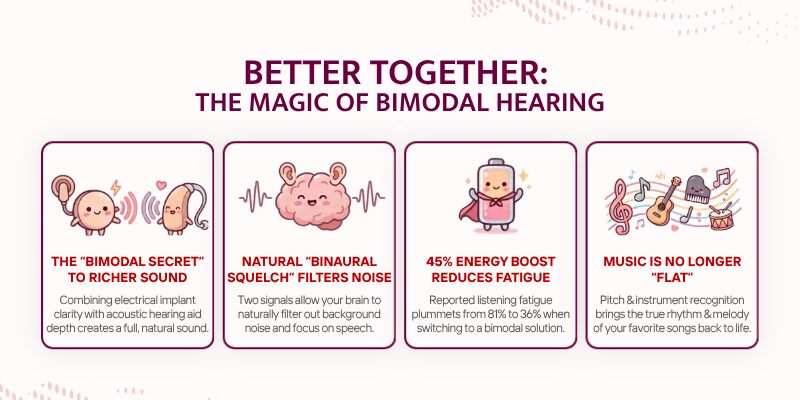
The primary reason bimodal hearing is so effective lies in the synergy between two different types of technology. A cochlear implant provides sound through electrical stimulation, which is exceptional for clarity and speech understanding but can struggle to convey the depth of lower frequencies. A hearing aid provides acoustic amplification to help fill those gaps.
In my practice, we often see patients find that the hearing aid provides the “prosodic information”—the rhythm, melody, and emotional nuances of speech—as well as crucial consonant voicing that the electrical signal of an implant might lack. This creates a significant “bandwidth advantage.” By providing wideband frequency amplification, bimodal hearing offers a more complete and natural sound picture than either device can achieve in isolation.
Takeaway 2: Your Brain’s Built-in "Squelch" System
Our brains are naturally designed to process sound from two sides to navigate complex environments. This relies on three natural auditory advantages: Head Diffraction, Binaural Redundancy, and Binaural Squelch.
We must consider the “Head Shadow Effect.” High-frequency sounds, which are vital for the clarity of speech, are physically blocked by the head and cannot “bend” (diffract) around to the other side. Having a device on both sides is the only way for the brain to “see” sound coming from the “shadowed” side. Once the brain receives signals from both ears, it activates its most impressive feature: Binaural Squelch. This is a cognitive noise-reduction system that decodes minuscule time delays and differences in loudness to “filter” the environment.
“Without two signals, the brain tries to retain all sounds (including the noise); with two signals, it can actively filter the background noise out.”
Takeaway 3: Music is No Longer "Flat"
For those using only a cochlear implant, music can often sound robotic because electrical signals struggle to convey pitch and fine temporal structure. Bimodal hearing transforms this experience by reintroducing the acoustic nuances of melody and tone.
Access to an increased audible acoustic bandwidth allows for:
- Better Pitch Perception: Clearer recognition of melodies and musical notes.
- Improved Timbre Recognition: A sharper ability to distinguish the “brightness” or “roughness” of a sound.
- Instrument Identification: A significantly higher success rate in identifying specific musical instruments.
- Fine Temporal Structure: A richer appreciation for the complex timing and layers within a piece of music.
To maximize these technical benefits, we recommend structured music training. Evidence suggests that engaging in this training for 12 months or more yields the strongest improvements in how the brain decodes these complex sounds.
Takeaway 4: The 45% Energy Boost (Reducing Listening Fatigue)
The most profound impact of bimodal hearing is often not just what you hear, but how you feel at the end of the day. Data shows a dramatic drop in reported listening fatigue when switching to a bimodal solution. In one landmark study, 81% of users reported feeling fatigued when using bilateral hearing aids; that number plummeted to just 36% after transitioning to bimodal hearing.
This happens because of “Binaural Redundancy.” When the brain receives two identical, redundant copies of a speech signal, it can effortlessly use the second copy to fill in any gaps masked by noise. This minimizes the constant cognitive strain required to process degraded audio. Modern bimodal systems even offer synchronized wireless audio streaming to both devices simultaneously, making phone calls and television viewing much more comfortable. By preserving this mental energy, users enjoy a higher quality of life and greater confidence in social settings.
Toward a "Deaf-Free India"
Bimodal hearing transforms hearing from a high-effort chore into a natural, spatial experience. By allowing the brain to localize sound and filter noise as it was meant to, we can mitigate the isolating effects of hearing impairment.
As part of my mission to achieve a “Deaf-Free India,” I advocate for early intervention and accessibility. If you find yourself exhausted by the effort of listening, I invite you to ask yourself: how much energy are you spending just to hear, and what would a richer, two-sided world of sound feel like for you?
Schedule a Consultation
To explore whether bimodal hearing is the right solution for you or your loved one, schedule an appointment with Dr. Shree Rao at EarSurgeon at earsurgeon.in
FAQs
What are the benefits of bimodal hearing?
Bimodal hearing benefits include clearer speech understanding, better sound localization, reduced listening fatigue, improved music appreciation, and easier communication in noisy environments.
How does bimodal hearing work?
Bimodal hearing works by using a cochlear implant in one ear and a hearing aid in the other ear. The cochlear implant provides electrical stimulation while the hearing aid amplifies natural acoustic sounds.
Is bimodal hearing better than using one device?
Yes, for many people with hearing loss, bimodal hearing provides a richer and more balanced hearing experience compared to using only a hearing aid or only a cochlear implant.
Can bimodal hearing improve speech understanding in noise?
Yes, bimodal hearing helps the brain filter background noise more effectively, making conversations easier to understand in crowded or noisy places.
Does bimodal hearing help with music listening?
Bimodal hearing can significantly improve music perception by enhancing pitch recognition, melody appreciation, and identification of musical instruments.
Who is a good candidate for bimodal hearing?
People with severe hearing loss who still receive some benefit from a hearing aid in one ear while using a cochlear implant in the other ear are often good candidates for bimodal hearing.