
A mother stands in the security queue at Hyderabad airport. Her son wears two processors, and she wonders if the scanner will harm them. In my practice, families ask me this before every holiday trip. The good news is that flying with cochlear implant devices is safe with some planning. This guide covers security, the cabin, packing, and overseas travel.
Flying With a Cochlear Implant: Airport Security Screening
Manufacturers state that airport scanners do not damage the implant or the processor. A metal detector or hand wand may still beep over the processor. Some people hear a short crackle near the scanner, and it passes quickly.
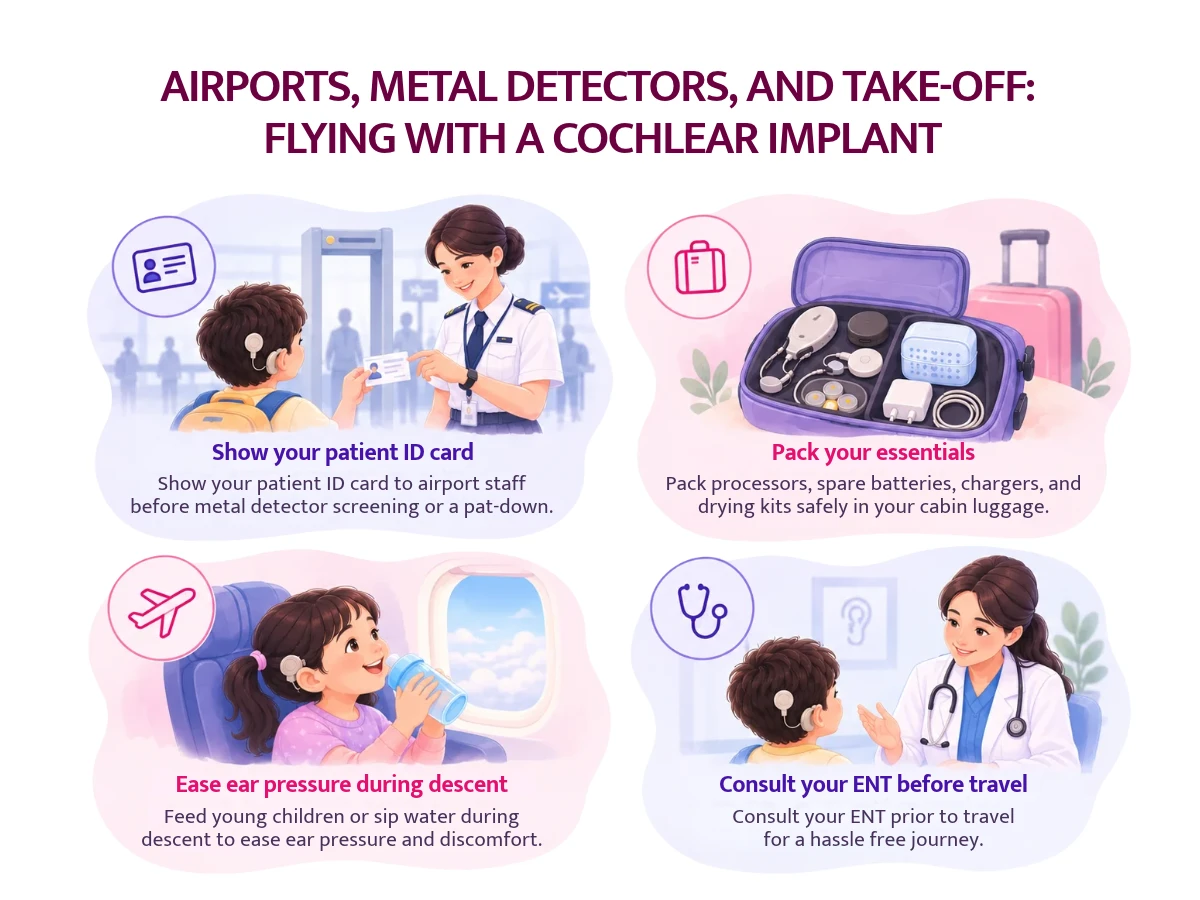
Tell the CISF officer about the implant before you reach the archway. Show the patient identification card that came with the device. Keep the processor on so your child can hear instructions. Switch it off near the scanner if the buzz bothers your child.
Brand guidance differs. Cochlear Limited states that its recipients may walk through metal detectors and full body scanners. Advanced Bionics notes that recipients may ask for a full-body pat-down with the processor inspected in place. An officer of the same gender performs the pat-down in India, and a private cubicle is available on request.
Never place a processor directly on the conveyor belt, because static electricity can damage it. Keep it in a small case inside your cabin bag.
On the Plane: Pressure, Processors, and Children's Comfort
Is it safe to fly with a cochlear implant?
Yes, flying is safe for people with a cochlear implant. A small pressure chamber study found no meaningful change in implant function after simulated flight. Most families keep the processor on throughout the flight. Chew, sip, or swallow during take-off and landing to ease ear pressure.
That study had only 11 participants, so larger studies would add confidence.
Cabin pressure drops during take-off and rises during descent. The ear equalises this pressure through the Eustachian tube, which is a narrow channel from the middle ear to the back of the nose. Young children have narrower tubes, so ear pain is more common. Start feeding a baby when descent begins. Give an older child small sips of water through a straw and small bites of banana. Doctors do not recommend decongestant medicine for children, because research shows no clear benefit.
Dr. Shree Rao explains how eardrum injuries happen in her guide to protecting ears during travel and sport.
Cabin announcements can be hard to follow in English, Hindi, or Telugu. Tell the crew at boarding that your child uses a cochlear implant. Ask them to face your child and repeat safety instructions.
Ask a doctor to review a child with a cold or fever a few days before the flight. Read about ear infections and cochlear implants for early warning signs.
Packing Smart: Spares, Batteries, Dry Kit, and Carry-On Rules
Pack everything for the implant in one small carry-on bag. Checked baggage faces stronger X-rays that can damage a processor. Include a spare processor if you own one, spare headpieces, cables, magnets, and a charger.
Pack batteries for the full trip plus 3 extra days. Airlines set different rules for lithium-ion batteries, so email your airline a week before you fly. Zinc air batteries make a useful backup, and power banks belong in the cabin bag.
Monsoon humidity and summer sweat can harm processors. Pack a dry box or silica gel sachets and use them every night. Review daily life with a cochlear implant so travel habits match your home routine.
International Travel: Service Centres Abroad and Device Insurance
Ask your manufacturer for the nearest authorised service centre at your destination. Carry a printed and a phone copy of your MAP, which is the saved listening program set for your ears. A clinic abroad can then reprogram or replace a processor.
Some manufacturers loan a backup processor for travel. Request it 4 weeks ahead, because the clinic must send your MAP to the company.
A warranty does not cover a lost or stolen processor. Insure the processor on a travel or home policy, and note the serial number and invoice value. Ask your health insurance provider in writing whether external devices are covered.
Plan Ahead Before Flying With Cochlear Implant Devices
Flying with cochlear implant devices is routine with three habits. Tell security early, ease ear pressure during descent, and pack spares in the cabin bag. Families who want a device check before travel can find guidance on booking an appointment with Dr. Shree Rao.
FAQs
Does my health insurance cover a lost processor?
Policies differ, so check the wording for external devices. Many health policies exclude lost or damaged equipment. A travel or gadget cover that lists the processor serial number may fill the gap.
When should I see a specialist before travel?
Book a device check at least 4 weeks before a long trip. Book sooner if your child has a cold. Families looking for the best cochlear implant specialist in India can arrange a pre-travel check with Dr. Shree Rao.
Can my child fly with a cold?
Ask your doctor to check the ears first. A cold can block the Eustachian tube, so pressure builds behind the eardrum. Delay the flight if there is ear pain, a fever above 39°C (102°F), or fluid from the ear.