
In my years performing cochlear implant surgeries, the moment of switch-on stays with me every time. A child hears their parent’s voice. A parent watches their child’s face change as sound enters the room for the first time. But that moment is not the finish line; it is the starting point. What follows, as the brain slowly learns to interpret electrical signals as speech and everyday sounds, is where the most important work happens. A technology called BEEP cochlear implant programming is now giving clinicians a much clearer window into that process.
The Mapping Problem
After cochlear implant surgery, an audiologist must “map” the device. This means setting the precise levels of electrical stimulation for each electrode inside the cochlea, calibrating how soft and how loud sounds should be, so the patient receives clear, comfortable hearing without discomfort.
For adults, this is manageable. They can describe what they hear. For infants and toddlers, or for patients with developmental challenges, the situation is fundamentally different. They cannot tell an audiologist when a sound is too loud or too soft. Clinicians have historically relied on behavioral cues, which are inconsistent, and on external scalp recordings that come with a significant technical limitation.
The Artifact Problem with Traditional EEG
For years, audiologists used Electroencephalography (EEG) to objectively measure brain responses to sound. By placing electrodes on the scalp, they could observe auditory activity in real time.
The cochlear implant itself made this extremely difficult. The device generates radiofrequency transmissions and rapid electrical pulses that create substantial electromagnetic interference at the scalp. This interference, called the Cochlear Implant Artifact, overwhelms the fragile neural signals researchers need to measure. It is the equivalent of trying to hear a whispered conversation next to a loudspeaker.
What is BEEP cochlear Implant Programming?
BEEP stands for Bionic Ear Evoked Potential Cochlear Implant Programming. It addresses the artifact problem by removing the need for external scalp electrodes entirely.
Instead of recording brain responses from outside the skull, BEEP uses the cochlear implant’s own internal electrode array to capture those responses. The implant delivers a precisely controlled electrical pulse to the auditory nerve, then immediately switches into recording mode. The same electrodes that stimulate the nerve pick up the electrical potentials generated by the brain’s auditory pathways as they travel back through the auditory system.
Because the recording happens inside the cochlea, the distance between the signal source and the sensor is dramatically reduced. Because the implant knows the precise timing of each pulse, it can mathematically separate the brain’s response from the device’s own electrical noise [1].
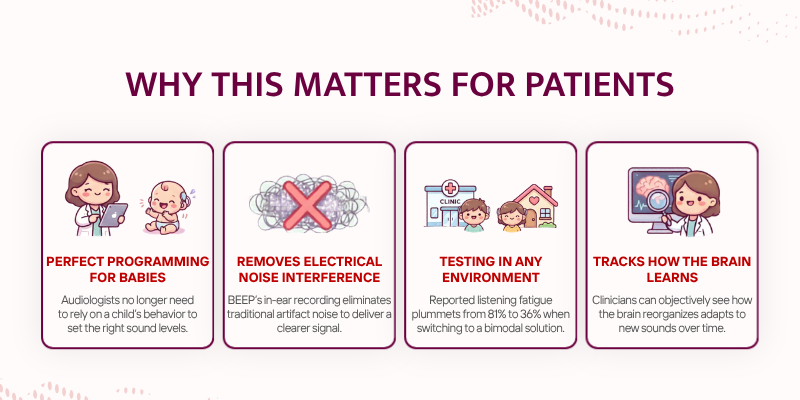
Why This Matters for Patients
The clinical implications of BEEP reach across several areas of cochlear implant care:
- Infant programming: Babies can receive cochlear implants at a very young age, and early auditory input is critical for language development. BEEP allows audiologists to map a device using objective brain data, without relying on behavioral feedback from a child who cannot yet communicate what they hear.
- Accessible testing: Standard EEG requires a shielded, noise-controlled laboratory environment. BEEP is entirely self-contained within the implant hardware, which means assessments could eventually be conducted in a standard clinic room or a home setting.
- Tracking brain adaptation: After implantation, the brain undergoes a gradual reorganization as it learns to process electrical signals as sound. BEEP provides an objective, ongoing record of this adaptation, helping clinicians identify patients who may need additional rehabilitative support.
- Bilateral implant coordination: For patients with implants in both ears, BEEP can measure how effectively the brain’s left and right auditory pathways are working together, which is especially relevant for locating sounds in noisy environments.
Where This Technology Is Headed
The broader direction is toward closed-loop cochlear implant systems: devices that not only deliver sound, but also monitor the brain’s response and adjust their own programming accordingly. BEEP is foundational to that future.
For families navigating the cochlear implant journey in India, this kind of objective measurement technology represents a meaningful step forward. It reduces dependence on subjective reporting during a phase when children are too young to describe their hearing experience, and it gives clinicians more reliable data to work with at every follow-up appointment. As India moves toward earlier newborn hearing screening and earlier implantation, tools like BEEP will become increasingly central to delivering precise, individually calibrated care.
If your child has been diagnosed with hearing loss, or if you have questions about cochlear implant candidacy and programming, you can schedule a consultation at Dr. Rao’s ENT Cochlear Implant Centre: https://earsurgeon.in/book-an-appointment/
FAQs
What is BEEP Cochlear Implant Programming?
BEEP Cochlear Implant Programming is an advanced method that uses the implant’s internal electrodes to measure the brain’s response to sound. It helps audiologists program cochlear implants more accurately, especially for children who cannot provide verbal feedback.
How is BEEP different from traditional cochlear implant mapping?
Traditional mapping often relies on patient responses and scalp-based EEG recordings. BEEP records auditory responses directly through the cochlear implant, reducing interference and providing more precise objective data.
Why is BEEP Cochlear Implant Programming important for infants?
Infants cannot describe what they hear, making device programming challenging. BEEP helps audiologists determine appropriate stimulation levels using objective brain responses, supporting early hearing and language development.
Can BEEP improve cochlear implant outcomes?
Yes. By providing more accurate information about how the auditory system responds to stimulation, BEEP can help optimize cochlear implant settings and potentially improve speech perception and hearing performance.
Is BEEP Cochlear Implant Programming available for bilateral cochlear implants?
BEEP has the potential to assess how both ears work together in patients with bilateral cochlear implants, helping clinicians evaluate auditory pathway coordination and sound localization abilities.
What is the future of BEEP Cochlear Implant Programming?
BEEP is expected to play a key role in developing closed-loop cochlear implant systems that automatically monitor brain responses and adjust programming settings for personalized hearing care.