One of the first things I tell parents after their child receives a cochlear implant is this: the device working well in the clinic does not guarantee it is working the same way at home. A cochlear implant or hearing aid can have a flat battery, a blocked microphone, or a loose connection. A young child cannot say “I cannot hear well today.” That is where the Ling Six Sound Check comes in. Understanding the cochlear implant speech frequency range in children that it covers is the first step to using it confidently as a parent.
Understanding the Cochlear Implant Speech Frequency Range in Children “What Is the Speech Banana?”
Before explaining the sounds, it helps to understand what audiologists call the speech banana. When a hearing test (pure tone audiogram) is plotted with frequency (pitch) on one axis and loudness on the other, all the sounds of human speech fall within a curved, banana-shaped region. This region spans roughly 250 Hz to 8000 Hz, at conversational loudness levels. Every consonant and vowel a person needs to understand spoken language sits somewhere inside that banana. A child whose hearing device does not cover this full range will have gaps in what they perceive, even if they appear to be responding to sound in daily life.
Why These Six Sounds?
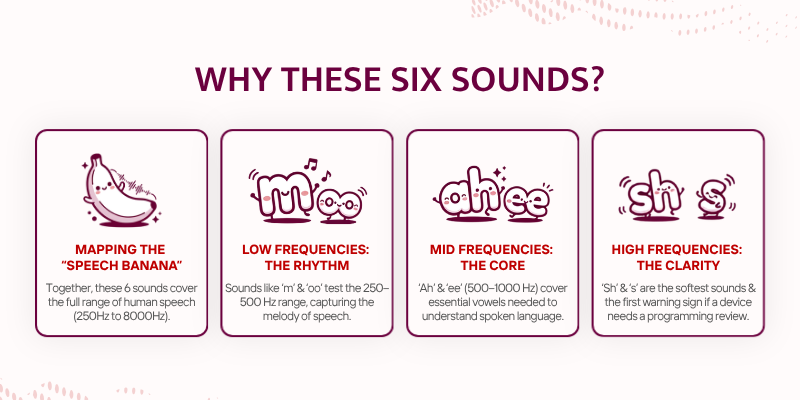
The Ling Six Sound Check was developed by Canadian audiologist Daniel Ling in 1976 and remains one of the most widely used daily monitoring tools in cochlear implant programs worldwide (Ling, 1976). The six sounds, ‘ah’, ‘ee’, ‘oo’, ‘sh’, ‘s’, and ‘m’, were chosen because together they sample the cochlear implant speech frequency range from one end of the speech banana to the other. No single sound covers all frequencies. Together, the six function like checkpoints distributed across the full map of speech. If a child detects all six, the device is most likely transmitting across the complete range needed for speech comprehension.
What Each Sound Actually Tests
The sounds divide into three broad frequency zones. The nasal ‘m’ and the vowel ‘oo’ sit at the low end of the speech banana, around 250 to 500 Hz. The vowels ‘ah’ and ‘ee’ occupy the mid-frequency range, roughly 500 to 1000 Hz. These lower and mid sounds carry the rhythm and melody of speech. The consonant ‘sh’ sits at approximately 2000 Hz, in the mid-high range. The consonant ‘s’ extends into the higher frequencies, around 4000 Hz and above. High-frequency sounds like ‘s’ are the softest and the first to be missed when a device is underperforming. A child who consistently misses ‘s’ is often the earliest warning sign that a programming review is needed.
A Note for Indian Families: These Sounds Exist in Your Language Too
A common assumption is that the Ling Check is designed for English-speaking children. The sounds themselves are phonemes, not English letters, and all six exist in Hindi and Telugu. The ‘म’ in Hindi and ‘మ’ in Telugu covers the ‘m’ sound. The vowels ‘आ’, ‘ई’, and ‘ऊ’ in Hindi, and ‘ఆ’, ‘ఈ’, and ‘ఊ’ in Telugu, map directly to ‘ah’, ‘ee’, and ‘oo’. The fricative ‘श’ or ‘శ’ covers ‘sh’, and ‘स’ or ‘స’ covers ‘s’. Parents can administer this check entirely in their own language. The frequency logic is identical regardless of the language used.
"My Child Hears Some Sounds But Not Others. Is That Normal?"
This question comes up regularly in clinic. In the months after activation, some inconsistency is expected, particularly for the higher-frequency sounds like ‘s’. A child who consistently fails to detect ‘sh’ or ‘s’ across multiple checks on different days, however, should be reviewed by their audiologist. This pattern may indicate that the higher-frequency channels in the device are not adequately programmed for that child’s hearing profile. It is not a sign that the implant has failed. It is a signal that the mapping session may need to be revisited.
What the Check Does Not Tell You
The Ling Six Check confirms whether sounds are being detected, not whether they are being processed or understood. A child who responds to all six sounds is receiving input across the cochlear implant speech frequency range. But language development, discrimination, and comprehension depend on consistent auditory-verbal therapy alongside a well-programmed device. The check is a daily indicator, not a substitute for formal audiological evaluation.
If your child uses a cochlear implant and you have questions about device performance or programming, a consultation with a cochlear implant audiologist can help. To book an appointment at Dr. Rao’s ENT Cochlear Implant Centre, visit earsurgeon.in/book-an-appointment.
FAQs
What is the cochlear implant speech frequency range in children?
The cochlear implant speech frequency range in children typically covers frequencies from approximately 250 Hz to 8000 Hz, allowing access to most speech sounds needed for language development.
What are the Ling Six Sounds and why are they important?
The Ling Six Sounds (‘ah’, ‘ee’, ‘oo’, ‘sh’, ‘s’, and ‘m’) represent different parts of the speech spectrum and help parents check whether a child’s hearing device is functioning properly.
How often should parents perform the Ling Six Sound Check?
Audiologists generally recommend performing the Ling Six Sound Check daily to ensure consistent access to speech sounds and identify potential device issues early.
Can the Ling Six Sound Check be done in Indian languages?
Yes. The six sounds used in the Ling Check exist in languages such as Hindi and Telugu, allowing families to perform the test comfortably in their native language.
What does it mean if my child cannot hear the 's' sound?
Missing the ‘s’ sound may indicate reduced access to high-frequency speech sounds. If this happens consistently, it is advisable to consult your audiologist for a device assessment and mapping review.
Does passing the Ling Six Sound Check mean my child understands speech perfectly?
No. The Ling Six Sound Check confirms sound detection across the speech range, but speech understanding, language development, and communication skills also require ongoing auditory-verbal therapy and rehabilitation.