Many parents of children with cochlear implants worry about whether speaking more than one language at home might affect their child’s language development. This concern is especially common among parents raising a cochlear implant bilingual child in multilingual households, where a child may hear Telugu at home while being educated in English at school.
Given the significant emotional and financial investment involved in cochlear implantation and rehabilitation, it is natural for families to want to make the best possible decisions for their child’s progress. One of the most common questions is whether continuing to use the mother tongue could interfere with learning English or create confusion.
Current evidence provides reassuring answers. In most cases, there is no need to stop speaking your mother tongue. In fact, maintaining rich and meaningful communication in the language you know best can be highly beneficial for your child’s development.
What research says about cochlear implant bilingual children
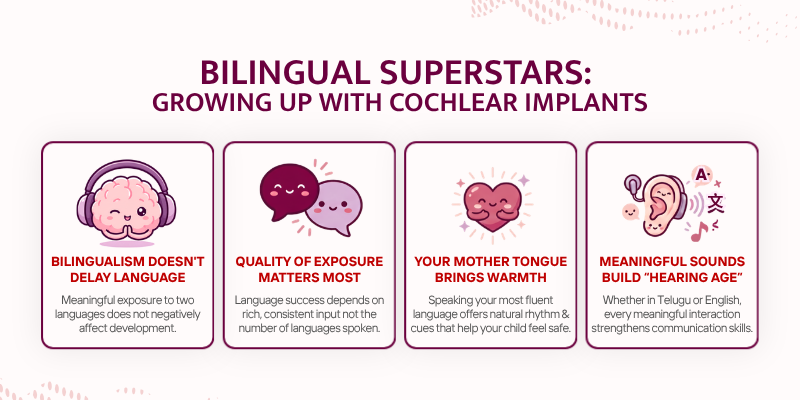
Studies generally show that bilingual exposure does not negatively affect language development in children with cochlear implants, provided they receive sufficient and meaningful exposure to both languages.
Children with cochlear implants have demonstrated the capacity to develop functional proficiency in two languages when given adequate, meaningful input in each. What matters more than the number of languages is the quality, quantity, and consistency of language exposure across both.
Children often become stronger in the language they hear most frequently. For example, a child who hears Telugu at home but spends much of the day in an English-medium school may eventually become more proficient in English. This is a normal reflection of language exposure rather than evidence that bilingualism is causing confusion.
Bilingual exposure itself is not considered a barrier to language development. Limited, inconsistent, or low-quality language input is more likely to affect outcomes.
Your mother tongue is not background noise
In hearing rehabilitation, there is an important distinction between meaningful sound and noise. Meaningful sound is anything that carries intent, emotion, and association for the child. Noise is everything else competing with it.
When you speak Telugu naturally, your voice carries warmth, rhythm, and emotional cues your child has already started to associate with safety and meaning. When a parent forces themselves to speak a language they are not fully fluent in, that naturalness can disappear.
Children learn language most effectively through rich, natural interactions with fluent speakers. A warm, expressive voice in Telugu is often more valuable than a hesitant or limited interaction in English.
The hearing age concept applied to a bilingual home
Hearing age refers to the total time a child has had access to meaningful sound through their device. A child implanted at 12 months who is now 2 years old has a hearing age of one year. The goal during that year is to maximise meaningful listening and language experiences.
In a multilingual household, language variety does not necessarily split that experience in half. A child counting in Telugu with their grandmother and learning colours in English at school is experiencing language in multiple meaningful contexts. Every meaningful connection made, in any language, contributes to communication development.
Practical guidance for Indian multilingual households
One strategy that some families find helpful is the “one caregiver, one language” approach, where one family member consistently speaks Telugu and another consistently uses English or Hindi. However, this is not essential. Many successful bilingual families use a variety of language patterns, provided exposure remains consistent, meaningful, and rich.
Beyond language choice, the more pressing concern is often background noise. Competing sounds such as a television running continuously, a pressure cooker, multiple conversations happening at once, or loud environments can present greater listening challenges for many children with cochlear implants than exposure to multiple languages.
Try to create quiet, focused listening opportunities each day, regardless of which language you are using.
Most importantly, use the language you speak best. The parent most fluent and expressive in Telugu should speak Telugu. Emotional fluency is itself a form of richness.
Maintaining your mother tongue can also support a child’s social and emotional development. Language is more than vocabulary. It is how children connect with parents, grandparents, family traditions, stories, humour, and culture. Preserving those connections can enrich communication and strengthen family relationships.
It is also important to remember that language outcomes depend on several factors beyond the language spoken at home. Early implantation, consistent device use, regular auditory-verbal therapy or speech rehabilitation, and active family participation all play major roles in a child’s progress.
The question behind the question
When parents ask about language, they are usually asking something deeper: “Am I making the right choices for my child?”
That anxiety reflects how seriously you take this responsibility.
The evidence is reassuring. Your mother tongue is not a liability. Your voice, your stories, and your songs in Telugu are irreplaceable parts of your child’s listening world. The goal was never to simplify their environment. The goal is to make every experience in it as meaningful and as consistent as possible.
If you have questions about your child’s progress after cochlear implantation, Dr. Shree Rao’s team is available for a consultation. Book an appointment at earsurgeon.in/book-an-appointment.
FAQs
Can a cochlear implant bilingual child learn two languages successfully?
Yes. Research shows that a cochlear implant bilingual child can develop proficiency in two languages when they receive consistent and meaningful exposure to both.
Will speaking my mother tongue confuse my child after cochlear implantation?
No. Children with cochlear implants are capable of learning multiple languages. Meaningful and consistent language exposure is more important than limiting languages.
Should parents switch to English only after their child receives a cochlear implant?
Not necessarily. Parents should communicate in the language they speak most naturally and fluently to provide rich language input and emotional connection.
Which language should be used at home for a cochlear implant bilingual child?
Families should use the language they are most comfortable speaking. Strong communication in the home language supports overall language development.
Does bilingualism delay speech and language development in children with cochlear implants?
Current evidence does not indicate that bilingualism causes language delays. Progress depends more on factors such as hearing age, therapy, device use, and quality of language exposure.
What factors contribute most to the success of a cochlear implant bilingual child?
Key factors include early implantation, consistent device use, regular speech and auditory rehabilitation, active family involvement, and meaningful exposure to both languages.